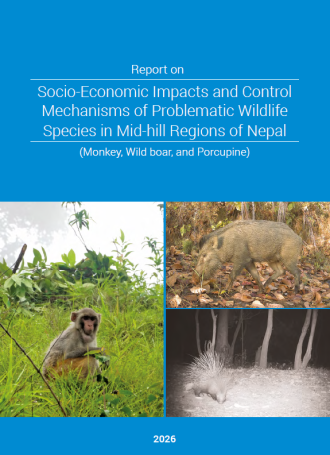
Socio-Economic Impacts and Control Mechanisms of Problematic Wildlife Species in Mid-hill Regions of Nepal (Monkey, Wild boar, and Porcupine).
Human-wildlife conflict (HWC) is a growing issue in Nepal, particularly in rural and semi-urban areas, where species such as rhesus macaques (Macaca mulatta), wild boars (Sus scrofa) porcupines (Himalayan crestless porcupine: Hystrix brachyura; Indian crested porcupine: H. indica) are frequent and cause significant damage to crop and makes troubled to local livelihoods. The study focused on estimating the population of rhesus macaques, identifying the presence of porcupines and wild boars and analyzing the economic impact of crop damage caused by these animals. Data were collected through literature review, field visits, stakeholder consultations, and questionnaire surveys. Conflict hotspot maps were created using Geographic Information Systems (GIS) to visualize the areas most affected by wildliferelated crop damage. Additionally, the study also evaluated the effectiveness of existing mitigation practices and propose site-specific solutions. The study recorded rhesus macaque populations across 44 Local level bodies (Municipality = 18) and Rural Municipality = 26) in mid-hill regions of Nepal, with an estimated 20,395 individuals observed directly and a projected a minimum of 104,137 individuals in the wider mid-hill region. In a troop, the number of rhesus macaque were upto 198 individuals. Average troop size was 42.66 individuals with troop density of 0.119/ km², with higher aggregation near agricultural land, settlements, and roads, demonstrating the strong influence of food availability and proximity to cropland.
Wild boar and porcupine were also widely distributed, with suitable habitats covering 69,353 km² and 64,081 km², respectively, across Nepal’s mid-hills and lowlands. Their occurrence was strongly associated with lower elevations, rivers, and forest proximity. Both species were reported as major crop pests, with hunting suggested as sport hunting, as found in other countries. The household survey (n = 1,846) revealed demographic patterns consistent with Nepal’s census data 2021 but showed limited available manpower for working in the agricultural field or guarding crop fields. Nearly all respondents (98%) mentioned monkeys as the most problematic animal, followed by porcupines (67%) and wild boars (31%). Key informants emphasized these concerns, also reporting barking deer (Muntiacus vaginalis) as secondary crop raiders and leopards (Panthera pardus) as major livestock depredators. Conflict was most severe in Bagmati, Gandaki and Sudurpashchim Provinces, with co-occurrence of multiple pest species especially high in Sudurpashchim.
Crop loss was extensively high in most parts of the study area, and the economy loss per year was around NPR 5 crore among 1,846 household from rhesus macaque. Corn was the most widely cultivated crop and the most heavily raided, with an average household loss of 312 kg/year (50.3% of production) and an economic loss of NPR 2.5 crore across the respondents. Rice, wheat, millet, potato, mustard, orange, and cardamom were also significantly affected, with loss proportions ranging from 18–52%. Province-wise, the highest relative losses were reported for corn in Gandaki (90%) and Karnali (88%), rice in Sudurpashchim (85%), and wheat in Sudurpashchim (90%), respectively.