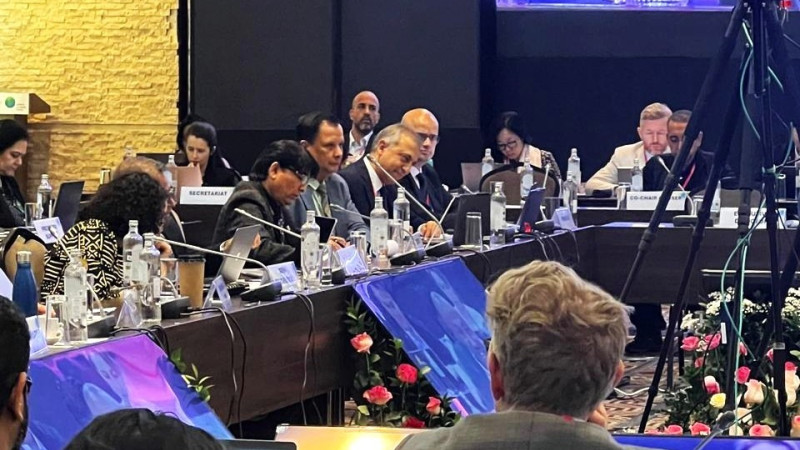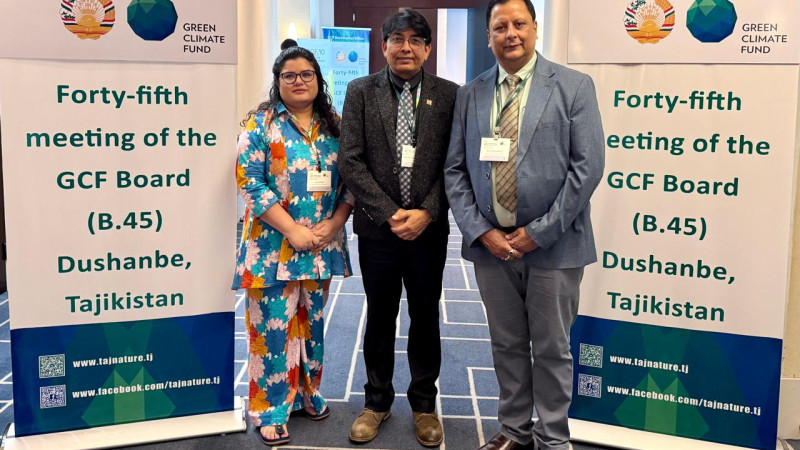
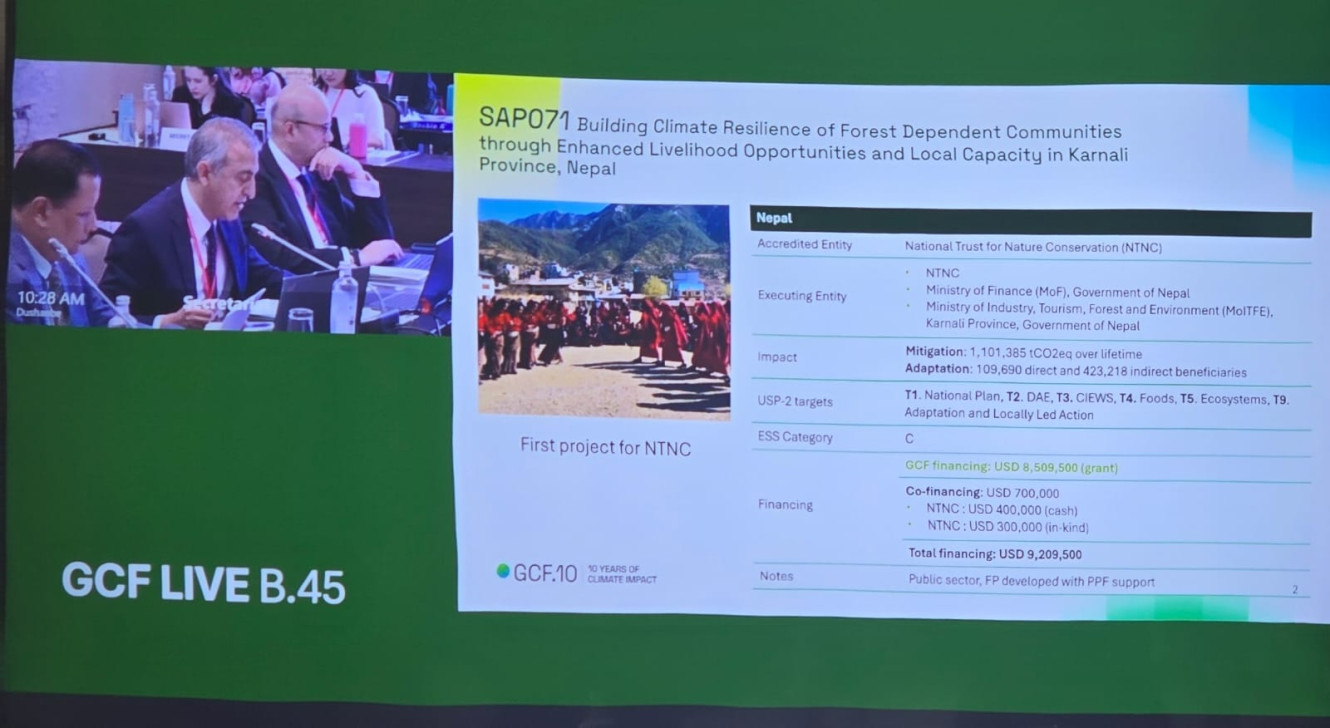
The 45th Meeting of the Green Climate Fund (GCF) Board has approved the funding proposal SAP071: "Building Climate Resilience of Forest-Dependent Communities through Enhanced Livelihood Opportunities and Local Capacity in Karnali Province, Nepal," marking another significant milestone in Nepal's climate finance journey.
The project has been developed by the National Trust for Nature Conservation (NTNC) in its capacity as a GCF Direct Access Entity (DAE) under the Simplified Approval Process (SAP). With a total investment of USD 9.2 million, including an USD 8.5 million grant from the GCF, the four-year initiative will strengthen ecosystem resilience, climate-resilient livelihoods and institutional capacity across one of Nepal's most climate-vulnerable provinces.
Karnali Province, characterized by fragile mountain ecosystems, difficult topography, high poverty levels and increasing exposure to climate-induced disasters such as landslides, floods and prolonged droughts, remains among the region’s most vulnerable to the impacts of climate change in Nepal. The project directly contributes to the implementation of Nepal's National Adaptation Plan (2021–2050), Nationally Determined Contributions (NDC 3.0) and other national climate priorities by translating climate policies into concrete action at the local level.
Through ecosystem restoration, nature-based solutions, climate-resilient livelihood opportunities, community-based early warning systems and strengthened local institutions, the project will directly benefit more than 100,000 people and indirectly improve the resilience of over 400,000 people across Karnali Province. Particular emphasis has been placed on ensuring meaningful participation and equitable benefits for women, Indigenous Peoples, Dalits and other marginalized and climate-vulnerable communities.
The project will be implemented through a partnership between national, provincial and local institutions. NTNC, as the GCF Accredited Entity, will also serve as the co-Executing Entity. The Government of Nepal will be represented by two additional co-Executing Entities: the Ministry of Finance (MoF), which will facilitate the flow and management of GCF resources, and the Ministry of Industry, Tourism, Forest and Environment (MoITFE), Karnali Province, which will lead the implementation of province-level interventions and coordinate project activities with participating local governments. This implementation arrangement reflects Nepal's federal governance structure and is designed to ensure strong coordination across all levels of government.
Reacting to the Board's approval, Hon. Gita Chaudhary, Minister for Agriculture, Forests and Environment and Chairperson of NTNC, described the decision as a significant achievement for Nepal's climate resilience agenda.
"This approval reflects Nepal's continued commitment to translating national climate policies into practical action that reaches our most climate-vulnerable communities. Through this investment, we are strengthening resilient ecosystems, improving sustainable livelihoods and advancing Nepal's commitments under the Paris Agreement while ensuring that no one is left behind."
Congratulating NTNC on the approval, Mr. Dhani Ram Sharma, Chief of the International Economic Cooperation Coordination Division and the National Designated Authority (NDA) Focal Point to the GCF at the Ministry of Finance, noted that the approval demonstrates Nepal's growing institutional capacity to access and manage international climate finance.
"The approval of this project demonstrates Nepal's increasing ability to mobilize and effectively manage global climate finance through national institutions. It represents another important step towards strengthening local adaptation, accelerating climate-resilient development and delivering tangible benefits to vulnerable communities."
Dr. Chiranjibi Prasad Pokheral, Member Secretary of NTNC, highlighted the significance of the approval for the institution.
"This achievement reflects NTNC's continued commitment to science-based conservation and locally led climate action. Working closely with government agencies, local governments and communities, we look forward to delivering lasting climate resilience through nature-based solutions while demonstrating the value of direct access to international climate finance."
The project proposal is the outcome of an extensive and evidence-based development process involving consultations with the provincial government, 31 participating local governments, community forest user groups, women's groups, Indigenous Peoples, technical experts and other stakeholders across the districts of Jajarkot, Jumla, Dolpa and Dailekh.
Reflecting on the Board’s decision, Dr. Manish Raj Pandey, Head of the Climate Change Department and GCF Primary Focal Point at NTNC, who led the overall development of the project proposal with the support of Ms. Lina Chalise, Senior Climate Change Officer and GCF Secondary Focal Point, emphasized that the approval represents the successful translation of Nepal’s climate ambitions into a transformational investment for vulnerable mountain communities..
"Today's approval by the GCF Board validates a locally led adaptation model that has been developed through an extensive consultative and evidence-based process. The project places communities firmly at the centre of climate action by integrating ecosystem restoration, resilient livelihoods, strengthened local governance and inclusive decision-making within a single investment framework. Over the next four years, the project will restore 1,000 hectares of degraded forest landscapes, strengthen sustainable forest-based enterprises, establish community-based early warning systems and enhance the adaptive capacity of local institutions. In addition, the intervention is expected to generate approximately 1.1 million tonnes of CO₂ equivalent mitigation benefits over a 20-year period. More importantly, this investment demonstrates how international climate finance can simultaneously reduce climate risks, strengthen biodiversity conservation, improve livelihoods and contribute to Nepal's long-term vision of climate-resilient and low-carbon development."
The funding proposal development process was partially supported by the UK Foreign, Commonwealth and Development Office (FCDO) through the Resilience, Adaptation and Inclusion in Nepal (RAIN) programme.
Following the signing of the Funded Activity Agreement, the project will enter its implementation phase, supporting forest-dependent communities across Karnali Province through locally led adaptation, sustainable forest management and climate-resilient livelihood opportunities. The project is expected to serve as a national model for scaling nature-based, community-driven climate adaptation while contributing to Nepal's commitments under the Paris Agreement and the Sustainable Development Goals..
Photos: